You can’t really understand Athens without understanding its coffee culture.
Not just what people drink, but how they drink it. In Greece, coffee is not something you grab on the way to your next meeting. It is part of the day itself. People spend hours over a single cup, chatting with friends, working, reading the newspaper, or simply watching the city go by. A café is not a pit stop. It’s a destination, and coffee is often just the excuse to be there.
Over the years, Greece has developed a coffee culture that blends old traditions with modern habits. From the traditional Greek coffee brewed in a briki to the freddo espresso that dominates the streets of Athens today, every drink tells part of the story.
For many visitors, it can all seem confusing at first. Menus are filled with unfamiliar names, almost everyone is carrying an iced coffee, and waiters ask questions you weren’t expecting. But once you understand the basics, it becomes much easier to navigate Athens’ café scene and appreciate why coffee plays such an important role in everyday Greek life.
Greek Coffee: Where It All Begins
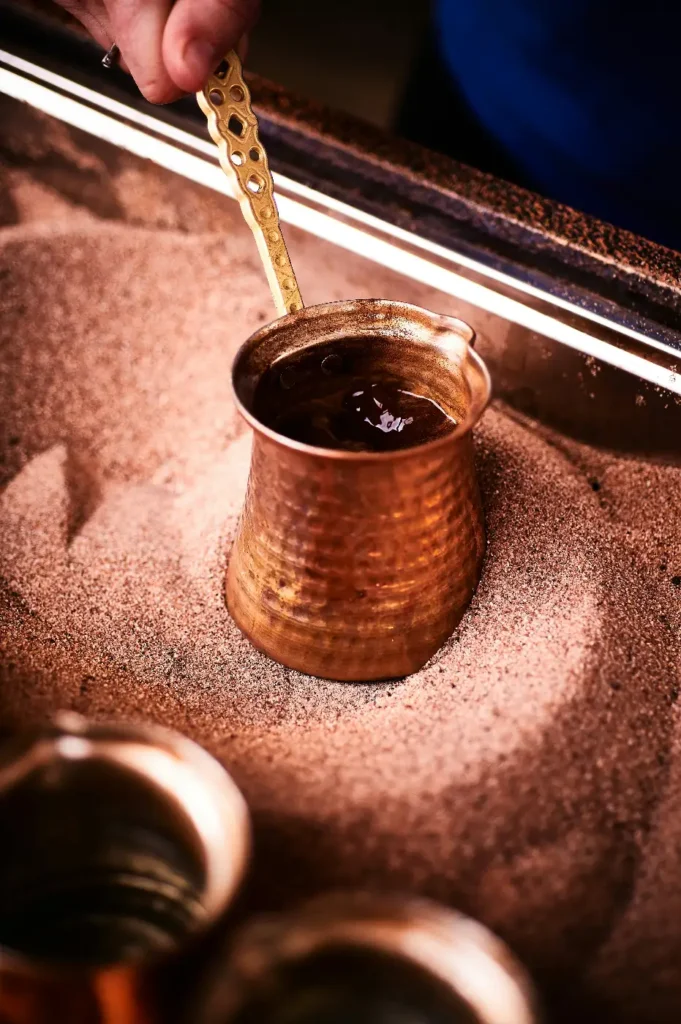
Greek coffee (Ellinikos Kafes) is essentially the same drink known elsewhere as Turkish coffee. The preparation method is identical, the brewing vessel is identical, and even the fine coffee grounds that settle at the bottom of the cup are identical. What changed is the name.
The coffee is prepared in a small pot called a briki, traditionally made of copper or stainless steel with a long handle. Water, finely ground coffee, and sugar are combined inside the pot and slowly heated over a low flame. The most important moment comes when a layer of foam, known as kaimaki, begins to form on the surface. For many Greeks, this foam is a sign of a properly prepared coffee. Just before it rises and spills over, the briki is removed from the heat and the coffee is poured into a small cup. From that point, patience is required. The coffee continues to settle inside the cup as the grounds slowly sink to the bottom. This is why Greek coffee is never stirred after serving, and why locals rarely drink the final sip.
Many visitors are surprised to learn that until the 1970s this drink was commonly called Turkish coffee in Greece. Following political tensions between Greece and Turkey, particularly after the Turkish invasion of Cyprus in 1974, the term “Greek coffee” gradually replaced it. The recipe remained exactly the same. Whenever I bring this up during food tours, most Greeks smile and shrug. “Politics,” they usually say. While many locals won’t be offended, referring to it as Turkish coffee can be seen as insensitive by some, so it’s best to stick with the local name when ordering.
Sugar is added during brewing rather than afterward, so you need to specify your preference when ordering – No sugar (Sketo), little sugar (Oligi), Medium sweetness (Metrio) and Sweet (Glyko).
In many traditional cafés and tavernas, your coffee will arrive with a small glass of cold water. You didn’t order it and you won’t be charged for it. It’s simply part of the ritual, based on the long-held belief that strong coffee should always be accompanied by water. Some places will also add something sweet on the side.
Frappé: The Accident That Became a National Drink
Few national drinks have an origin story as accidental as the frappé. In 1957, during an international trade fair in Thessaloniki, a Nestlé representative named Dimitris Vakondios wanted a coffee break but couldn’t find any hot water. Improvising, he mixed instant coffee with cold water in a shaker that was being used for chocolate drinks. The result was a cold, foamy coffee that turned out to be surprisingly good.
And just like that, the frappé was born.
Within a few years, it had spread throughout Greece and become the country’s unofficial summer drink. The preparation remains simple: instant coffee, a little cold water, and sugar are whipped together using a small handheld mixer until a thick foam forms. Ice, cold water, and sometimes milk are added afterward. But the popularity of the frappé was never really about the taste.
Throughout the 1980s and 1990s, it was impossible to imagine a Greek beach, square, or café without people sitting for hours with a frappé in hand. It was cheap, refreshing, and stayed cold for a long time. More importantly, it fit perfectly into the Greek way of spending time. The frappé wasn’t just a coffee. It was a companion to long conversations, lazy afternoons, and endless people-watching. You could sit with one for hours without feeling rushed.
Today, its popularity has declined, especially among younger Greeks who have embraced espresso-based drinks. Still, on a scorching summer afternoon, a frappé remains one of the most authentically Greek experiences you can have.
Like Greek coffee, frappé is ordered according to sweetness level, and could be made with or without milk.
Freddo espresso: The Coffee of Modern Athens
If frappé defined Greece in the 1990s, freddo defines Athens today. During the early 2000s, Greece experienced an espresso revolution. Espresso had existed before, of course, but it was often associated with hotels, upscale restaurants, and more formal settings. Most people still drank Greek coffee or frappé. The challenge was obvious. Greece is hot, and Greeks spend a lot of time outdoors. A hot espresso quickly loses its appeal when temperatures climb above 35°C (95°F). The solution was brilliantly simple.
A freshly brewed double espresso is poured into a metal shaker with ice and sugar (if wanted), shaken vigorously for a few seconds in a dedicated machine. It uses a spindle with a blending disc at the bottom to spin at extremely high speeds. The interaction between the hot coffee and the ice creates a delicate layer of foam that has become the drink’s signature. The result is everything people love about espresso, but cold, refreshing, and perfectly suited to the Mediterranean climate.
Today, it’s almost impossible to walk through Athens without seeing people carrying a freddo. Students, office workers, taxi drivers, and retirees all seem to have one in hand. In nearly every café, you’ll see the same ritual repeated countless times each day. The barista pulls a double espresso, pours it into a shaker filled with ice, stirs it vigorously, and serves it. The entire process takes less than a minute.
Freddo Cappuccino: The Softer Version
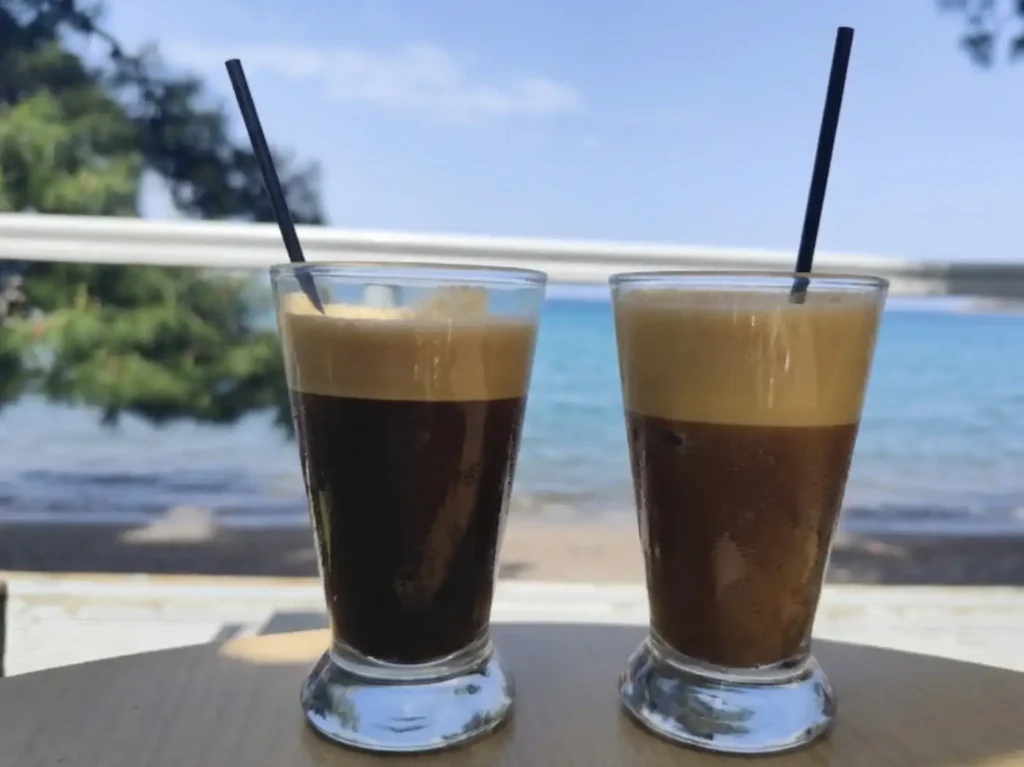
For those who prefer something creamier, there’s the freddo cappuccino. It begins exactly like a freddo espresso: double espresso, ice, and a metal shaker. The difference comes at the end, when a thick layer of cold milk foam is added on top. This is not steamed milk like an Italian cappuccino. The foam is prepared cold using a separate frothing device and has a denser texture than most visitors expect. The result is a smoother, creamier drink that feels slightly more substantial and is particularly popular during long summer afternoons. Many Greeks don’t stir it immediately, preferring to drink through the milk foam and let the flavors gradually blend together.
What You Should Know About Sitting in a Greek Café
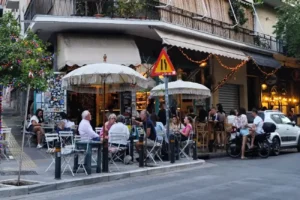
To understand Greek coffee culture, you need to understand one simple thing: Greeks don’t go to cafés just to drink coffee. They go to spend time.
Your waiter will not return every ten minutes to check on you. They will not rush to clear your table, and they certainly won’t bring the bill unless you ask for it. For many visitors, this can initially feel like slow service. For Greeks, it’s simply good manners.
This is one of the reasons Athens’ cafés are always busy. People aren’t necessarily there because they need caffeine. They’re there because cafés remain one of the city’s most important social spaces.
The bill, please.
You can learn a lot about Athens through its coffee.
From the traditional Greek coffee brewed in a briki, to the frappé that became a national icon, to the freddo that dominates the city today, each drink reflects a different chapter in modern Greek life. But ultimately, the story is not really about coffee itself, it’s about time. Coffee in Greece is an excuse to sit a little longer, talk a little more, and slow down for a while. And perhaps that’s the most Greek thing about it.