There is something almost philosophical about phyllo dough. A single sheet is translucent, fragile, nearly weightless — press it between your fingers and it dissolves. Stack twenty sheets with butter between them, add nuts and honey, slide it into a hot oven, and something extraordinary happens: it becomes architectural. Shattering, golden, perfumed. Greek phyllo pastry is one of those rare culinary achievements where the simplest technique — layer, butter, bake — produces results of extraordinary complexity. For the serious food lover, following phyllo across Greece means following an entire civilization’s relationship with pleasure, hospitality, and the land.
A Brief, Layered History
The origins of phyllo are genuinely contested, and the argument is worth having. The technique of stretching dough into thin sheets most likely arrived in the eastern Mediterranean from Central Asian traditions, carried and refined through the kitchens of the Byzantine Empire and later the Ottoman court in Constantinople. Byzantine bakers had been working with thin-layered doughs since at least the medieval period; the Ottoman palace kitchen elevated this into a precise art form.
What the Greeks did — and what makes their tradition distinct — is adapt this technique to their own landscape. Greek phyllo pastry is not the Ottoman version transplanted; it is a local interpretation shaped by what was available: wild greens from mountain terraces, fresh cheeses from island herders, honey from thyme-covered hillsides, walnuts from Peloponnesian groves. The dough became a vessel for whatever the land and season offered.
The modern chapter of Greek phyllo has a specific geography. After the population exchange of 1922–23, hundreds of thousands of Greeks from Anatolia and Constantinople resettled in northern Greece, bringing with them a more refined phyllo tradition shaped by centuries of proximity to imperial kitchens. This is one reason Thessaloniki still holds a distinct standing in Greek pastry culture: a deeper Ottoman imprint, a more sophisticated layering technique, a wider vocabulary of filled pastries.
Fun fact: The word phyllo comes from the Greek φύλλο — meaning simply “leaf.” A reference to how thin the dough should be, and how it should fall, light as a fallen leaf, when held up to the light.
The Dough Itself
Phyllo is a deceptively simple dough: flour, water, a little olive oil, and sometimes a touch of vinegar or lemon juice to improve elasticity. No eggs, no butter, no enrichment. The magic is entirely in the technique — stretching the dough until it is thin enough to read a newspaper through, then layering it with fat (clarified butter in most sweet pastries, olive oil in many savory ones) to keep the sheets separate during baking. The fat creates steam; the steam creates flake; the flake creates that irreplaceable crunch.
Traditional hand-stretched phyllo is pulled across the backs of both hands and over the surface of a large table — a single sheet can reach a meter across before it tears. Machine-made phyllo dominates commercial production and is thinner and more uniform, but lacks the slight irregularity that gives handmade phyllo its characteristic texture and bite.
Different regions approach the dough differently. In Crete, phyllo tends to be slightly thicker and oilier. In northern Greece, it is stretched as thin as possible. In most of the islands, olive oil replaces butter entirely. These are not minor distinctions — they produce categorically different pastries.
Phyllo Across the Regions
Attica and Athens — the collector
Athens has always been a gathering point for regional traditions rather than the originator of one. The city’s pastry shops reflect this: baklava, galaktoboureko, kataifi, spanakopita — all present, all excellent, all arriving from somewhere else. What Athens does best is source well: honey from Hymettus, pistachios from Aegina, cheeses from across the country. The quintessentially Athenian phyllo experience is the spanakopita slice — spinach and feta baked in large sheet pans and sold by the piece from neighborhood bakeries. Every bakery has its own formula. Regulars are intensely loyal.
Must try: spanakopita (spinach pastry) by the slice from a neighborhood bakery — plain, unpretentious, and often extraordinary.
Thessaloniki and Northern Greece — the refined tradition
The north is where Greek phyllo reaches its most sophisticated expression, shaped by Byzantine, Ottoman, Sephardic, and Macedonian influences layered over centuries. Thessaloniki phyllo is stretched as thin as technically possible, buttered generously, and handled with precision. The city’s pastry culture is a serious business — dedicated bougatsa shops open at dawn and close when the day’s supply runs out, usually by mid-morning.
Must try: Trigona Panoramatos— cone-shaped phyllo shells filled with airy vanilla custard, a Thessaloniki invention. Bougatsa – a quintessential Greek pastry consisting of creamy custard filling layered between sheets of crispy, buttery phyllo dough. While it can be savory, the most popular version is Bougatsa me Krema—a sweet treat filled with semolina-based custard, vanilla-scented, and dusted generously with icing sugar and cinnamon.
Epirus and the Northwest — the rustic mountain tradition
Epirus produces the most emphatically savory phyllo culture in Greece. Here, pita means something specific: thick, hand-rolled phyllo brushed with olive oil and filled with whatever the mountain season offers — wild greens, local cheese, sometimes meat or eggs. The phyllo technique is deliberately rustic, thicker and slightly uneven, producing a chewier result with a pronounced dough flavor. Less architectural flakiness, more sustenance and depth. The vocabulary is enormous: hortopita (wild greens), kreatopita (meat), galopita (milk pie), and dozens of hyper-local variations that change by valley.
Must try: Hortopita — wild greens, olive oil phyllo, and nothing else.
Crete — the ancient island tradition
Cretan phyllo is almost always made with olive oil rather than butter, producing a denser, richer result with a fruitier character. The island’s long isolation meant its pastry culture developed on its own terms, and it remains fiercely autonomous. Cheese-filled pastries dominate over custard ones, and sweetness is deployed with more restraint than on the mainland.
Must try: Kalitsounia— small folded or open-faced pastries filled with fresh mizithra cheese, sometimes sweetened with honey and cinnamon. Xerotigana, spirals of fried phyllo-like dough drenched in honey and crushed walnuts, traditionally made for weddings and celebrations.
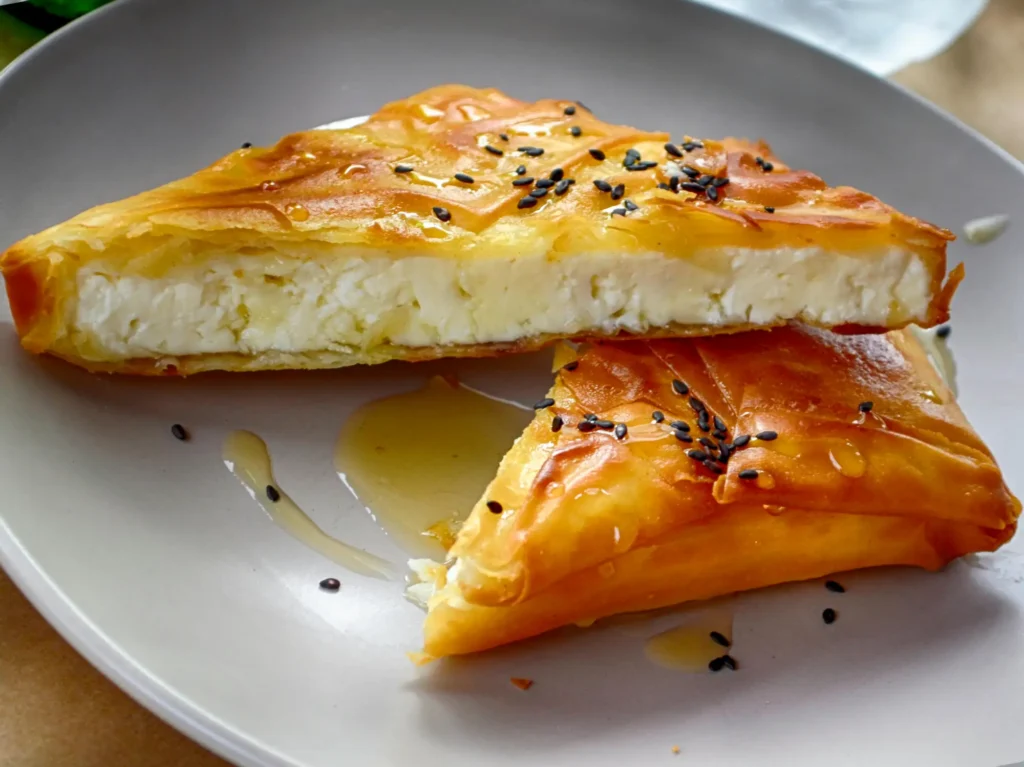
Feta me Meli (feta with honey), also known as Meliasti, is a known Greek meze that masterfully balances the salty tang of sheep and goat milk feta with the floral sweetness of honey. The dish typically features a thick slab of feta wrapped in buttery, crisp phyllo pastry, then drizzled with aromatic thyme honey and sprinkled with toasted sesame seeds. While it is popular all around Greece and can be found in most local tavernas, the practice of serving honeyed feta is particularly deep-rooted in the island of Crete.
What Makes a Great Phyllo Pastry
A few principles hold true wherever you are eating:
Fat matters — Phyllo baked with insufficient fat becomes dry and brittle rather than flaky. When locals describe a pastry as stingy, they almost always mean the butter or oil was held back.
The syrup — In sweet pastries, syrup is poured onto hot pastry, or hot syrup onto cold — never hot on hot, which causes uneven absorption. A good Greek thyme honey — from Hymettus or Crete — transforms the result entirely.
Handmade vs. commercial phyllo — The difference is real and worth seeking out. Handmade phyllo has slight thickness variations that produce more textural complexity in the finished pastry. If a bakery makes it by hand, order everything on the counter.
Phyllo as Dessert Architecture
While phyllo is often associated with savory pies, its most intriguing transformation happens when it moves fully into the world of desserts—not as a wrapper for fillings, but as the structure itself. In these cases, phyllo stops being a container and becomes the body of the cake.
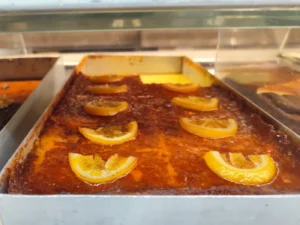
The most iconic example is portokalopita, an orange cake that breaks nearly every rule of traditional pastry. Instead of carefully layered sheets, the phyllo is deliberately shredded, dried, or crumpled, then folded into a batter infused with yogurt, eggs, and orange zest. Once baked, it is soaked in citrus syrup. The result is dense yet porous, like a sponge that has absorbed sunlight—sweet, aromatic, and intensely moist without feeling heavy.
Even more visually striking is kataifi, where phyllo is not in sheets at all but in fine, thread-like strands. These strands are wrapped around nuts—usually walnuts or pistachios—rolled into nests or cylinders, baked until crisp, and then drenched in honey or syrup. The texture is what defines it: crisp edges that fracture into syrup-soaked interiors, somewhere between pastry and confectionery architecture.
What makes both desserts fascinating from a culinary perspective is how they invert the logic of phyllo. In savory pies, phyllo creates separation and structure—layers that stay distinct and flaky. In desserts like portokalopita and kataifi, that structure is intentionally disrupted. The pastry is broken, shredded, or reshaped so that it can fully absorb syrup, turning from crisp to saturated.
These desserts also mark a shift in regional influence. Kataifi has clear roots in the broader Ottoman pastry tradition, while portokalopita is a more modern Greek invention, likely emerging in the mid-20th century as home cooks experimented with leftover phyllo sheets and citrus-heavy syrups.
Together, they show that phyllo is not just about layering—it is about transformation. Whether crisp and architectural or soaked and collapsing, it remains the same idea in different states of tension: flour, fat, and time pushed to their limits.
Conclusion
Phyllo is not defined by a single recipe but by a technique that has absorbed centuries of regional adaptation, historical layering, and cultural exchange. From savory pies shaped by geography to syrup-soaked desserts that push the dough beyond its structural limits, it remains one of the clearest expressions of how Greek cooking turns simple ingredients into something architecturally and sensorially complex. To follow phyllo is ultimately to follow a living tradition—one that continues to evolve without losing its essential logic of thinness, layering, and transformation.